
- Published on
Digital Twin: When Buildings Finally Start to Speak
- Expert view
By Éric Bernier, CanBIM CP, Director of Digital Strategy
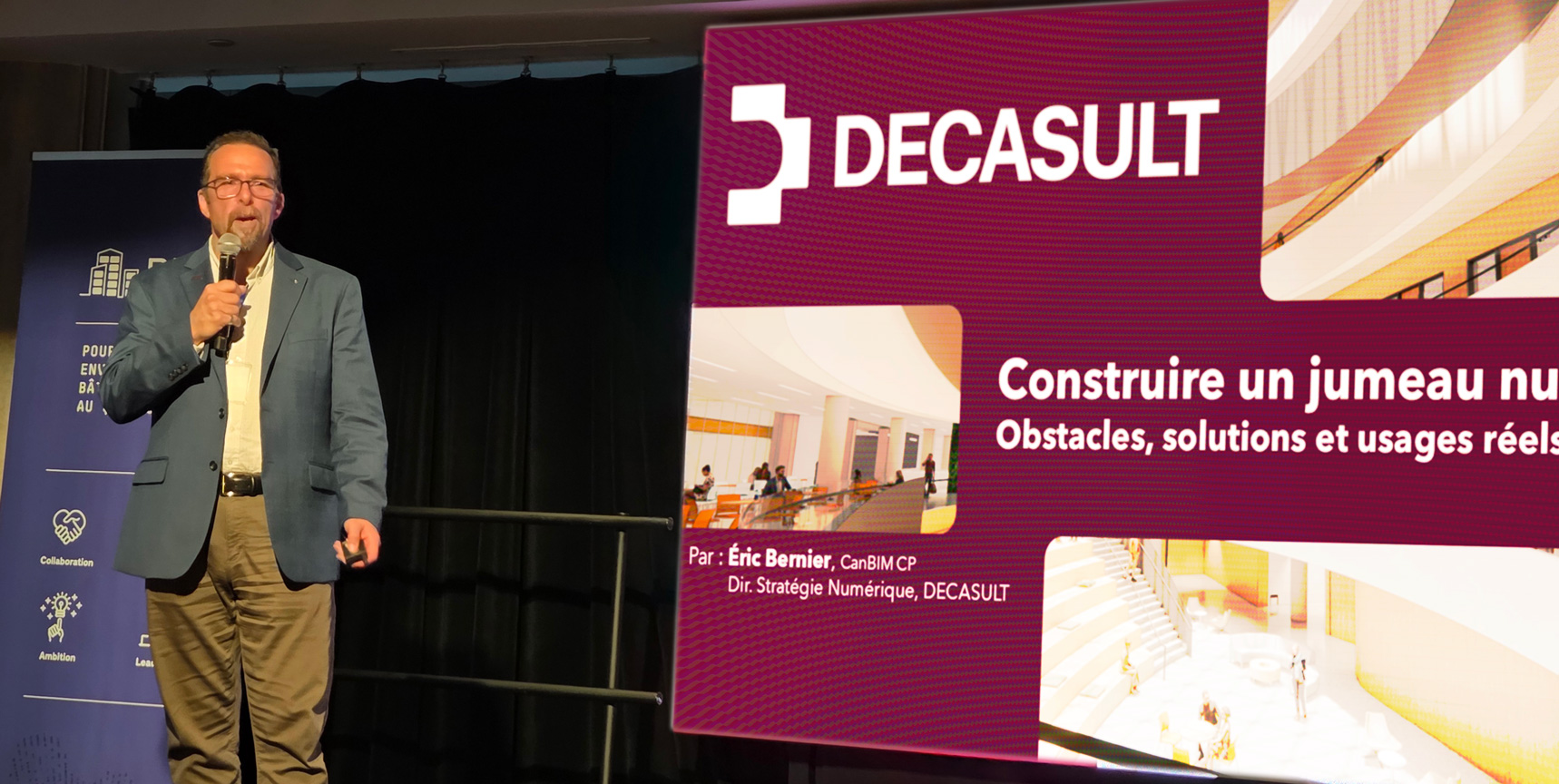
In the real estate industry, a paradox constantly arises.
Organizations manage assets worth millions—sometimes even billions—yet still have a fragmented understanding of their own buildings.
Incomplete or outdated plans. Scattered documentation. Technical data that is difficult to access. Maintenance history spread across multiple systems.
In the field, that’s one of the things I notice most often.
A building owner who purchases a building rarely inherits the data that would truly enable them to manage it. Architects deliver a 3D model—sometimes a complete BIM model—but once the project is complete, the owner often doesn’t know how to make use of it. The model ends up being overwritten and replaced by 2D drawings in a maintenance management system. All too often, that’s where the data’s journey ends.
This is precisely where the digital twin comes into its own. Still very new in Quebec, perceived as an emerging technology or an abstract concept, the digital twin is still often misunderstood.
Yet its potential is immense. And above all, very concrete.
more than just a 3D model
“In my conversations with property managers, I often notice a gray area between what BIM is and what a digital twin actually is.”
BIM is, above all, a structured process for managing building information, which relies on 3D modeling. However, depending on the teams’ level of maturity and the project’s requirements, the quality and depth of this information may vary.
The digital twin takes this concept even further by connecting building data to its operational reality, integrating dynamic information such as temperature, humidity, space occupancy, equipment status, energy consumption, maintenance, alerts, and maintenance history.
The building is no longer merely represented. It becomes observable, measurable, and controllable.
This difference completely changes the nature of the tool. We no longer consult a plan; we interact with a living system.
The Real Challenge: Data
Contrary to what one might think, the main obstacle is not technology. The tools already exist. The real challenge lies in the quality and organization of the data.
In many buildings, the plans are no longer up to date. BIM models, when they exist, are often underutilized after handover. This is a major loss.
Because a digital twin is only as good as the data on which it is based. If equipment is misnamed, misclassified, or poorly documented, or if parameters are incomplete or inconsistent, the system’s full potential is undermined.
This is often the first issue we need to address with clients. Before discussing sensors, artificial intelligence, or dashboards, we must first rebuild a reliable foundation.
What Organizations Are Really Trying to Solve
In Quebec, the market is still in its infancy. Organizations aren’t yet calling up and saying, “I want a digital twin.” Instead, they come to us with specific issues:
- A facility manager who can’t quickly locate critical equipment.
- A security team unable to pinpoint the exact locations of certain sensors or cameras.
- Energy-inefficient buildings without a detailed understanding of what’s causing the energy losses.
- Underutilized spaces that are impossible to optimize due to a lack of reliable data.
- Maintenance teams that still operate in a reactive mode.
It is these very pain points that pave the way for the digital twin. And when you look at them together, the potential becomes clear.
Because it allows you to centralize, visualize, and connect information that would otherwise remain scattered. It eliminates operational friction.
And when you scale these gains across an entire real estate portfolio, the benefits quickly become transformative—in terms of efficiency, performance, and decision-making alike.
Start small to create value quickly
A common mistake is trying to do everything at once. Energy. Operations. Maintenance. Security. Performance. IoT. Everything, everywhere, all at the same time.
“My experience has shown me that this is rarely the right approach. A digital twin must be built gradually. You start with a specific need—a real problem—an initial use case. Then you develop the system from there.”
That’s exactly the approach we take at DECASULT: an iterative, evolving, and pragmatic approach. Because a digital twin doesn’t have to be massive from day one to generate value.
Learning Through Hands-On Experience
Since the Quebec market is still emerging, DECASULT has chosen to do what few players are still doing: experiment in the field.
We launched a pilot project at our Montreal offices to gain hands-on experience with the entire implementation process that a client will go through. At the same time, partners such as Groupe Petra are closely following this process and are already exploring with us how to apply it to their own real estate portfolio.
This process follows a clear five-phase roadmap.
- Phase 1, assessment and scoping, involves determining the building’s current state: the quality of existing documentation, the availability of plans, digital maturity, and the identification of priority use cases.
- Phase 2, data preparation, aims to structure the information, update or reconstruct existing models, classify equipment, and consolidate technical documentation.
- Phase 3, platform deployment, integrates this data into a centralized, structured, and actionable environment.
- Phase 4, system integration, then connects sensors, IoT devices, building management systems (BMS), and maintenance tools to bring the digital twin to life in real time.
- Phase 5, training and adoption, ensures that teams take ownership of the tool and can truly integrate it into their daily practices.
This approach makes it possible to prioritize use cases and build digital maturity step by step, along with its constraints, blind spots, and lessons learned. Because the real world always reveals nuances that presentations don’t show, and that’s often where true value is created.
Europe is leading the way. Results that speak for themselves.
While Quebec is still in its early stages, Europe already offers several concrete examples that provide a better gauge of the digital twin’s true potential.
These experiences are invaluable because they help reassure stakeholders, validate certain hypotheses, and accelerate collective learning. Above all, they demonstrate that the benefits are not merely theoretical. Far from it.
In several deployments observed in France, the results documented in SpinalCom’s white paper indicate:
- operating cost reductions of up to 20 to 30%;
- a 40 to 50% optimization of space utilization;
- better planning of CAPEX and OPEX investments;
- as well as maintenance that is more predictive than reactive.
Based on the cases studied, the return on investment generally ranges from 12 to 18 months.
These results are obviously no guarantee, but they demonstrate one essential point: the potential is real, and above all, it is measurable.
This observation is consistent with the findings of McKinsey (2025), which highlight that digital twins can improve operational efficiency and resource allocation by 20 to 30% in public infrastructure projects, while promoting better planning of CAPEX and OPEX investments as well as more proactive asset management.
In some cases, organizations using these approaches have even identified potential savings exceeding $100 million through investment optimization and improved maintenance planning.
Thus, although the benefits vary depending on the context and the maturity of the organizations, the convergence of results observed in the field and international analyses confirms that digital twins are a credible lever for improving infrastructure performance, reducing costs, and maximizing the value of investments.
Advancing Best Practices, Together
The digital twin is not just a passing trend. It represents a natural evolution in asset management, enabling a more detailed, connected, and proactive understanding of buildings.
Of course, certain obstacles remain, particularly the perception that it requires a significant investment. However, it would be a mistake to believe that everything must be transformed all at once. The true strength of the digital twin lies precisely in its ability to evolve with the organization, adapt to its needs, and grow as the organization matures.
At DECASULT, this progressive approach is deeply rooted in our DNA. Collaboration, a multidisciplinary approach, and the evolution of practices are at the heart of our approach.
The Quebec real estate sector already includes organizations ready to take on this pioneering role. And it is within this collective dynamic that the greatest opportunity lies: working together to develop more efficient, sustainable, and beneficial ways of doing things for the entire industry.
Good questions inspire good content.
Would you like us to cover a specific topic? Is a particular challenge worth exploring? Contact us.

