
- Published on
Value Analysis: A Governance Tool for Better Decision-Making
- Expert view
By Andréanne Martin, M.A., VMA, Value Analysis Specialist and Proposal Manager
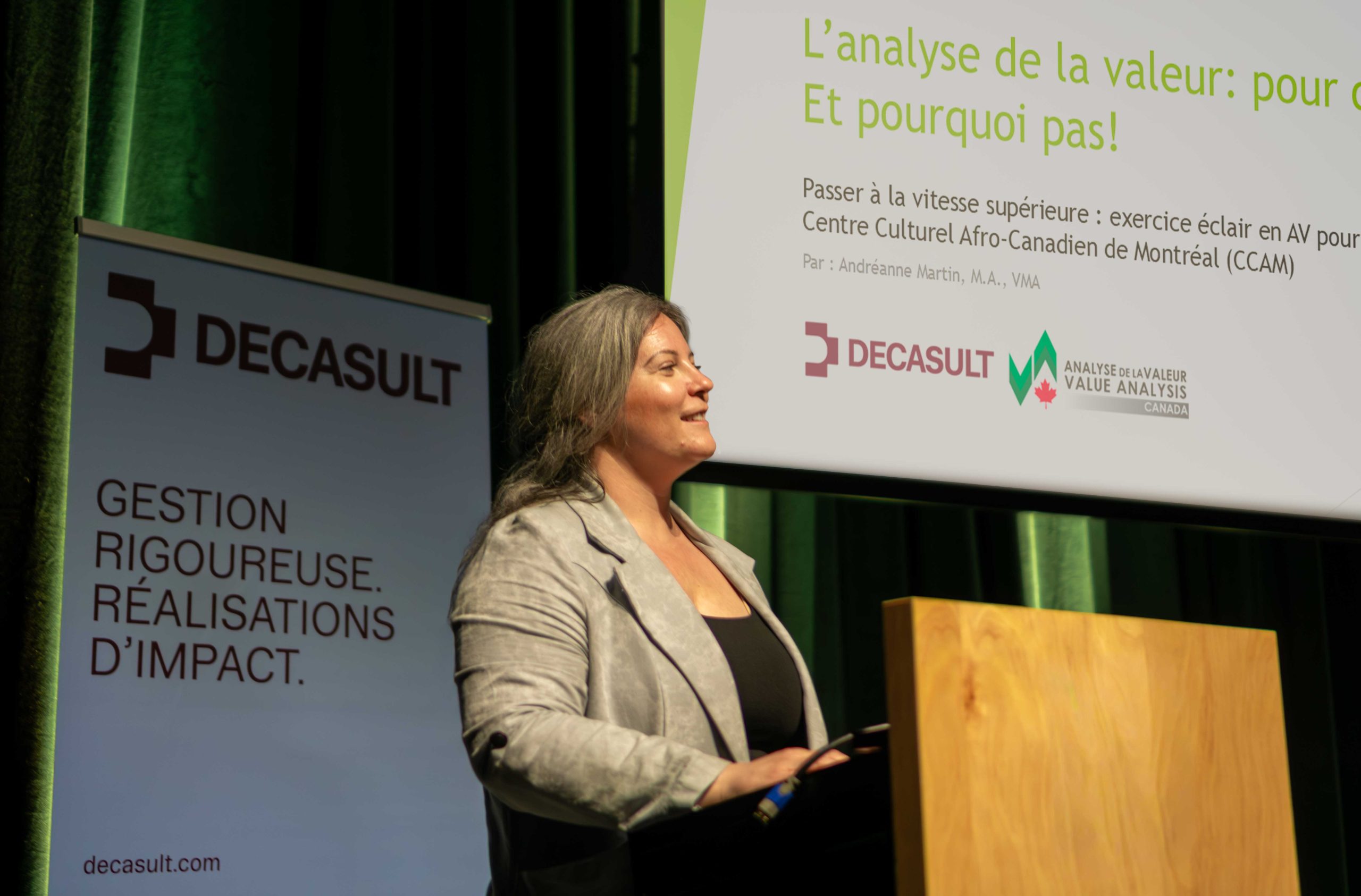
In construction projects, the pressure is constant: balancing acceptability, performance, constraints, and a multitude of stakeholders, all while making decisions that must be understood, justified, and defended over time.
Often viewed as a one-off exercise conducted early in the process, value analysis is now part of a broader approach. It can be applied at different stages of the project, with a single goal: to bring clarity to the choices that need to be made and to strengthen the consistency of decisions.
“In my practice, what I notice most often is not a lack of tools, but a difficulty in structuring decisions at the right time, with the right level of information.”
Andréanne Martin
It is precisely at these critical moments that value analysis comes into its own. It helps clarify strategic directions, document them, and ensure true alignment between needs, functions, and the selected solutions.
Beyond the Instinct to Cut Costs
Value analysis is still frequently initiated when a project exceeds its budget. The instinct is immediate: cuts must be made.
But where should cuts be made? And on what basis?
In my experience, this situation reflects a common confusion between cost reduction and value optimization.
In fact, the approach is based on a fundamentally different logic: it is not about scaling back a project, but about better understanding what it is meant to achieve.
It is based on a recognized international methodology structured in six phases as defined by Value Analysis Canada:
- Information: understanding the project, its constraints, and its objectives.
- Functional analysis: identifying, prioritizing, and weighting essential functions.
- Creativity: generating realistic and innovative alternative solutions.
- Evaluation: comparing options based on well-defined criteria.
- Development: exploring the selected options in greater depth.
- Presentation: providing clear and well-documented recommendations.
At the core of this approach, functional analysis is crucial. It helps distinguish between what is essential and what is superfluous and prevents trade-offs from being dictated solely by budget constraints.
When this type of approach is integrated in a structured manner, it delivers measurable results. For example, the City of Calgary has incorporated value analysis as a requirement for its major infrastructure projects. Since 2011, any project exceeding $25 million must undergo one analysis, and those exceeding $75 million require two.
Based on several years of implementation, the observed results are significant:
- An average reduction or deferral of life-cycle costs of approximately 16%.
- A return on investment exceeding $160 for every dollar invested.
- A study cost representing, on average, between 0.25% and 0.4% of the total project cost.
“Closer to home, the Centre culturel afro-canadien de Montréal (Montreal Afro-Canadian Cultural Centre), with whom we are collaborating on a project management assignment, has clearly benefited from the value analysis workshop we facilitated. This exercise resulted in a 15% reduction in the budget, without compromising the program or the essence of the project.”
This case also demonstrates that, even for a smaller-scale project with a shorter timeline, the value analysis methodology can be applied simply and effectively: the exercise is not tedious and can be completed quickly, without impacting the project schedule.
In my view, these findings confirm one thing: when planning is structured early on, there is real room for maneuver, and the benefits far exceed the simple logic of cost reduction.
Skipping this exercise can be very costly.
When Project Coherence Takes Shape
The deviations we observe in projects rarely stem from a simple budget issue. More often than not, they are rooted in a lack of clarity or alignment between the stated needs, the expected functions, and the selected solutions.
These discrepancies emerge very early on, particularly during the definition of the functional and technical specifications.
Good questions inspire good content.
Would you like us to cover a specific topic? Is a particular challenge worth exploring? Contact us.

